
Hidden Tree Decay & Structural Failure in Cherokee County Hardwoods
A tree can look healthy and still be decaying inside. Here’s how to spot the warning signs of wood decay before a hardwood fails near your home.
1. Green Leaves Don’t Mean a Healthy Tree
Throughout Woodstock, Canton, and Holly Springs, one of the most common mistakes homeowners make is thinking that “a tree with green leaves is a safe tree.” Tree crews often meet homeowners who are shocked after a large 80-foot Southern Red Oak or Water Oak falls on a garage or bedroom roof in moderate 35 mph wind gusts, even though the tree had healthy-looking leaves all summer.
To see why this happens, it helps to know the two main parts of a mature hardwood trunk:
- Sapwood (the outer layer): The living ring just under the bark. It carries water and nutrients between the roots and the leaves. As long as this thin outer ring stays hydrated, the tree keeps growing green leaves.
- Heartwood (the inner core): The dense, non-living wood in the center of the trunk. It doesn’t carry water. Its only job is to hold the tree up against wind and its own weight.
2. What We Found Inside the Trunk
Below is a photo taken during a residential tree removal done by Supreme Arbor, LLC in Cherokee County. From the ground, the hardwood looked solid, with intact bark and a normal-looking canopy. But tapping the trunk and inspecting it before the work began showed clear warning signs of wood decay.
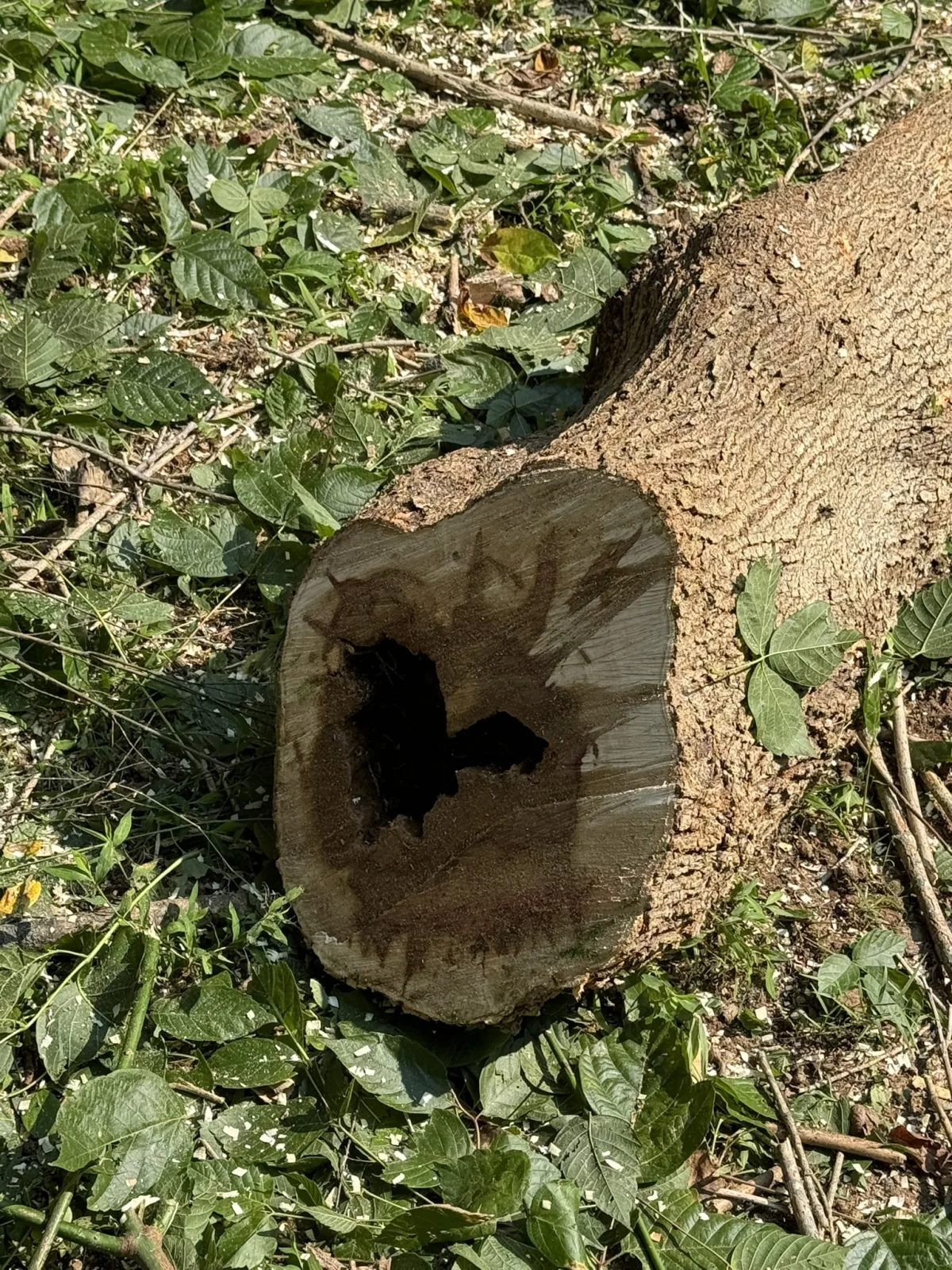
This cut trunk shows two ways wood decay makes a tree fail:
- The tree can’t keep the decay contained: Trees naturally try to wall off damaged or decaying wood (arborists call this CODIT, a model from Dr. Alex Shigo). In mature trees weakened by root stress or old wounds, those walls can break down and the decay spreads, leaving soft, crumbly wood in the center.
- A crack through the weak center: Notice the vertical crack running from the decayed center out to the bark. When wind pushes on the canopy, a hollow or decayed core can’t handle the strain, so the trunk can split lengthwise and fail suddenly.
3. Common Wood Decay Types in Georgia
In Georgia’s humid Piedmont climate, several kinds of wood decay fungi thrive. Spotting the mushroom-like growths they produce is one of the best early warnings that a tree may be decaying inside:

| Wood Decay Type | Trees It Affects | How Serious It Is |
|---|---|---|
| Warted Oak Polypore (Inonotus dryadeus) |
Red, White, and Water Oaks | Severe: Rots the large roots at the base of the tree. The tree can tip over with no warning from the leaves. |
| Varnished Shelf Mushroom (Ganoderma curtisii) |
Oaks, Maples, Sweetgums | High: Rots the lower trunk and the base where the roots begin, leaving the wood weak and brittle. |
| Honey Mushroom (Armillaria mellea) |
Hardwoods and Pines | Extreme: Spreads underground and rots the roots that hold the tree up. Often follows construction damage. |
| Hypoxylon Canker (Biscogniauxia atropunctata) |
Drought-stressed Oaks | Very serious: Bark peels off to show silver-black patches. The wood turns brittle and can break in sections quickly. |
4. The 5 Visible Warning Signs of Wood Decay
You don’t need special equipment to spot the outside signs of decay inside a tree. When you walk around your property, check the base of the trunk, the area where the roots spread out, and the main branches for these five signs:
1. Wood Decay & Mushrooms at the Base
Any shelf-like mushroom growing out of the bark, out of an old pruning cut, or from the ground within three feet of the trunk means the wood inside is very likely decaying.
2. Two Trunks Joined in a Tight “V”
When two main trunks grow together in a tight “V” instead of a wide “U,” bark gets pinched between them. This keeps the trunks from growing together solidly and traps rainwater, which can start deep wood decay inside the fork.
3. Holes, Hollows, and Animal Nests
Woodpeckers often go after insects living in soft, decaying wood. Steady woodpecker activity along the main trunk is a strong warning that the wood inside is decaying.
4. Vertical Cracks & Swellings
A vertical crack with raised, bulging edges (often called a “frost crack” or “rib”) means the tree is trying to seal off a split inside. In strong wind, these cracks can act like a hinge and let the trunk break.
5. Soil Lifting at the Base
Check the soil on the side opposite the way the tree leans. If the soil is cracked or raised, or roots are pulling out of the red clay, the roots holding the tree may have broken, and the tree could fall at any time.
5. Testing a Suspect Tree & Getting an Independent Arborist Opinion
When a site visit finds possible decay, arborists follow standard evaluation steps based on ISA tree owner guidance:
- Tapping the Trunk (Sounding): Striking the trunk with a mallet at regular spots around it. Solid wood gives a clear, sharp ring. Hollow or decayed wood gives a dull thud, which helps an experienced evaluator map where the decay is.
- Independent Certified Arborist Report: When a permit, a dispute with the city, or an insurance claim calls for formal paperwork, Supreme Arbor works with independent ISA Certified Arborists who can use specialized testing, such as drilling tests or sound-wave scans, to produce a detailed map of the decay inside the trunk. Supreme Arbor is an active member of the Georgia Arborist Association (GAA).
6. Removing a Decayed Tree Safely
Removing a tree with decay inside takes a very different approach than removing a healthy one. Because the center of the trunk is weak, climbers and crews follow strict safety rules (see our guide to tight-space tree removal and aerial rigging in Cherokee County):
- Multiple Safe Anchor Points: Climbers should never tie in to just one questionable branch or trunk fork. Using two ropes attached at separate, solid points keeps the climber protected from a fall.
- Smaller, Gentler Cuts: Decayed wood can’t handle sudden jolts. Crews make smaller, lighter cuts and lower the pieces with low-stretch ropes through friction brakes at the base, so falling wood never slams into the weakened trunk. Homeowners comparing tree removal pricing factors will find that hazardous jobs often call for crane help or aerial rigging systems.
- Specialized Equipment: When a decayed tree stands directly over a house and climbing is unsafe because the trunk is hollow, Supreme Arbor can coordinate specialized equipment when appropriate, including crane-assisted tree removal. Crane use depends on tree characteristics, site access, surrounding structures, and overall project requirements.
Cherokee County Legal & Permitting Framework:
Does your decaying tree sit within a protected municipal stream buffer or require a tree removal permit? Read our comprehensive legal guide: Cherokee County Tree Removal Laws & Homeowner Guide.
Frequently Asked Questions
Q1: Does Cherokee County require a permit for residential tree removal?
It depends on the property. Some single-family residential properties are exempt from tree removal permits, but trees in stream buffers, conservation areas, or other protected zones can require approval. Confirm with Cherokee County or your city before removal, and see our Cherokee County tree removal laws guide.
Q2: Does Supreme Arbor provide crane-assisted tree removal?
Supreme Arbor can coordinate specialized equipment when appropriate, including crane-assisted tree removal. Crane use depends on tree characteristics, site access, surrounding structures, and overall project requirements.
Q3: What happens to the wood chips and logs after removing a decaying tree?
Options include hauling away the wood and debris, leaving wood chips on the property, or cutting suitable wood for firewood. Arrangements are confirmed with property owners prior to work.
Q4: Does Supreme Arbor have certified arborists on staff?
Supreme Arbor does not employ a Certified Arborist. Supreme Arbor works with independent ISA Certified Arborists when a project requires certified evaluation or reporting.
Q5: Is Supreme Arbor licensed and insured in Cherokee County?
Yes. Supreme Arbor, LLC is fully registered and carries $2 million in Commercial General Liability Insurance. Supreme Arbor is also an active member of the Georgia Arborist Association (GAA). Certificates of Insurance (COI) are provided upon request.
See Also: Authoritative Regional Resources & Guides
Tree Removal Canton GA | Low-Impact Tree Care & Removal
Professional low-impact tree removal, crane coordination, and storm cleanup in Canton, GA.
Read Full Report →Cherokee County GA Tree Removal Laws | 2026 Homeowner Legal Guide
Authoritative legal guide on single-family zoning exemptions, stream buffers, and permits in Cherokee County.
Read Full Report →Tree Removal Woodstock GA | Certified Tree Care & Hazard Removal
Precision residential and commercial tree removal across downtown Woodstock and Towne Lake.
Read Full Report →References & Statutory Authorities
- [1] Wikipedia Encyclopedia. Arboriculture Foundation & Technical Standards. Authoritative Reference.
- [2] Wikipedia Encyclopedia. Tree care Foundation & Technical Standards. Authoritative Reference.
- [3] Wikipedia Encyclopedia. Pruning Foundation & Technical Standards. Authoritative Reference.
- [4] O.C.G.A. § 51-1-1. Georgia Act of God Defense & Natural Hazard Rule. Authoritative Reference.